Courtyard Classroom: DigiSakhi’s Day in Hiran Chapada
Under the shade of bamboo and neem in Hiran Chapada, a small tribal hamlet in Madhya Pradesh, a group of women gathered to take their first confident step toward digital banking. Through simple conversations on bank accounts, UPI, OTPs, and PINs, the workshop aimed to replace fear with understanding and help women feel more secure in managing money online.

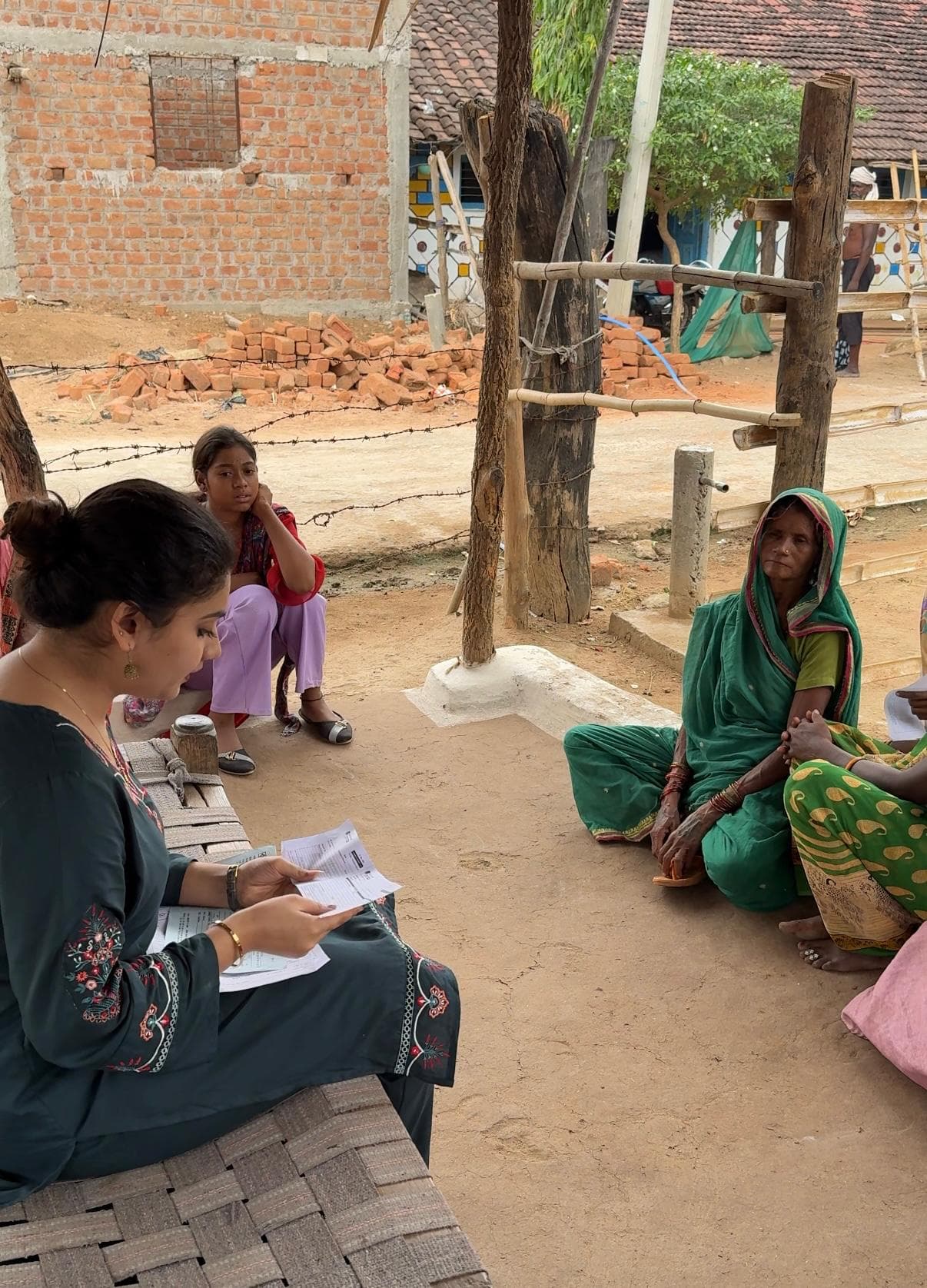
A village afternoon that felt like a turning point
Under a shade of bamboo and neem, with half-built brick homes behind us and the day’s work humming in the lanes, we gathered with a small circle of women in Hiran Chapada, a tribal hamlet in Madhya Pradesh. Some sat on the woven cots, others on the packed earth, green odhnis framing curious faces. A little nervous laughter gave way to focused silence as we opened our first page: “Bank khaata kyun? Aur UPI kaise?” (Why a bank account and UPI how?)
This was not just a workshop. It was the next step in a campaign we’ve been building since early June meeting women where they are, in their language, at their pace to replace fear of online banking with confidence.

Why this mattered here?
Many women in Hiran Chapada handle daily purchases, run small home enterprises, or manage SHG (self-help group) savings but digital banking felt distant. We heard familiar concerns:
“Phone pe galat dab gaya toh?”
“Paise kahin atak na jayein?”
“OTP aur PIN ka farq?”
These aren’t just questions; they’re barriers to income security.
Our goal is simple: financially literate women who can independently use digital banking tools from balance checks to UPI payments and bank transfers.
What we carried in and why it worked?
Smartphone & Laptop: Live demos, screen mirroring, and one-on-one practice
Visual Aids: Posters and handouts in simple Hindi with icons (PIN ≠ OTP, do’s/don’ts)
Voice-based Guides: For participants with low literacy
UPI Apps (PhonePe/Paytm), RTGS overview, Mobile Banking: Real-time practice
The Demo Day
The first demo was ordinary and, therefore, monumental. Balance check. Mini statement. A one-rupee transfer from my account to a volunteer’s and back again. When Shanti bai’s transfer made that little ping, she covered her mouth and then laughed out loud, a sound that moved around the circle like a breeze. It wasn’t the rupee; it was the proof. Fear loosened its grip.

Fear left quietly, the smile stayed loudly
The heart of the session was not information; it was rhythm. Try, see, repeat. We mirrored the phone screen for the group, then put the same steps back into their hands. Scan. Confirm. Enter PIN in private. Wait for the chime. We kept the steps short and the stakes tiny. No one had to be brave; they just had to be curious for a few more seconds than their fear. “Aaj se main karungi,” said a younger participant as she finished her first mobile recharge. “Bhaiya ko bolne ki zaroorat nahi.” It wasn’t rebellion. It was relief.
We talked about safety, not like a warning but like a routine. PIN and OTP are never shared. Unknown links are never tapped. Customer care numbers come only from official apps, not from a forward or a search result. If money is stuck, we don’t panic; we follow the in-app help, raise a ticket, and wait for the bank’s process to finish. To make it stick, we chanted the rules together and laughed at our own seriousness.
What changed in two hours was small on paper and huge in spirit. Before we began, fewer than half could clearly explain the difference between PIN and OTP; by the end, almost everyone could repeat it back and show it on the screen. Every participant completed at least one real task—checking a balance, sending a test rupee, or doing a small recharge. No one left with a confused face. Many left with a new habit: asking the right questions before pressing the next button.
Running this kind of learning day is simple and surprisingly affordable. A few posters, mobile data, a bit of travel, and we are ready about a thousand rupees for an entire village visit, funded from our own pocket for now. The cost is light, the outcome is heavy!
People often think financial inclusion is a government scheme or a form you submit. We have learned it’s closer to learning to ride a bicycle. Someone holds the seat, you pedal on a quiet lane, and one morning you look back and realise you are moving on your own. Hiran Chapada was that quiet lane for us- a small afternoon that will ripple for months.
If you were there, you would have seen it: the moment a one-rupee chime turned into a sentence-Main kar sakti hoon.
And once that sentence lands, the rest is just practice.
DigiSakhi Team
We are a grassroots initiative running free digital banking workshops across rural India.
You might also like
DigiSakhi Partners with Indian Bank for Women’s Financial Literacy
A step toward making digital banking simple, safe, and accessible for women through financial literacy and confidence-building.
Wonder Women with UPI: A Field Note from Faridabad
On an automotive factory floor in Faridabad, women who handle precision machines with confidence still hesitated when it came to using UPI. DigiSakhi turned this hesitation into learning by designing short, shift-friendly sessions that connected digital payments to concepts they already understood—process control, safety checks, and verification. Through ₹1 practice transfers, scam-awareness drills, and simple rules like never sharing PINs or OTPs, the women began using digital money with confidence, proving that unfamiliarity, not inability, is the real barrier.

Promoting Financial Literacy in India: Advancing DigiSakhi’s Mission for Women’s Financial Empowerment
Financial literacy in India is no longer just about opening bank accounts; it is about helping people, especially women, understand and confidently use financial tools. Despite progress through government schemes and digital banking, many women still face barriers such as low awareness, language gaps, mistrust, digital fear, and limited decision-making power. DigiSakhi aims to bridge this gap by making financial and digital literacy simple, practical, and accessible, empowering women to make informed choices and turn financial access into real independence.